
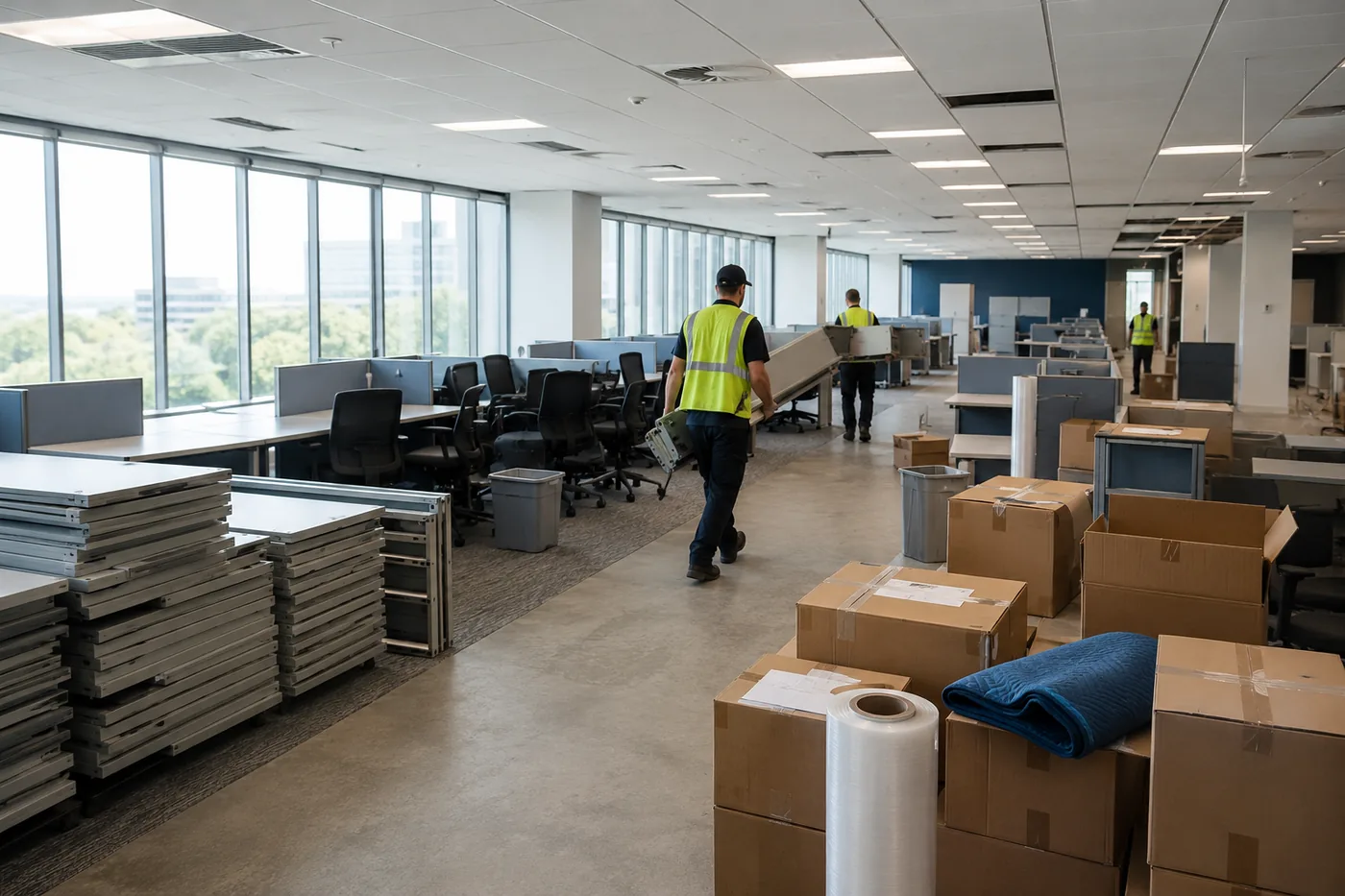
When an office lease ends, the space has to go back to the landlord in the condition the lease requires. Usually that means “broom clean” – empty, swept, and free of debris. Anything more is spelled out in the surrender clause of the lease. You need to clear out furniture, cabling, fixtures, and equipment by the lease end date.
Read the surrender clause first
The surrender clause in your lease sets out what the landlord expects back and what counts as damage. Some leases require the space returned to the bare condition it was in before you moved in. Others allow built-in improvements to stay and require you to remove only the furniture and equipment. Some leases require you to remove the network and phone cabling above the ceiling, a requirement that is easy to overlook and expensive to learn about during the walk-through.
Ask the property manager to confirm in writing anything in the clause that is unclear. The security deposit, and any holdover rent charged for days the space is returned late, depend on the surrender clause and whether the space meets its requirements on the last day.
Set the timeline from the lease end date
The landlord’s walkthrough typically happens a day or two before you return the keys, so clearing and cleaning must be finished by the walkthrough, not by the lease end date. Plan backward from the walkthrough date.
We suggest starting the planning when the lease has at least 90 days left. A single floor can be cleared in days once the plan is set, but the decisions before that take longer than the teardown itself. You have to decide what stays, what moves, what sells, and what gets recycled or disposed of. Building access, freight elevator reservations, and loading dock hours may also have to be booked, and downtown building management often limits that work to nights or weekends.
Inventory everything in the space
Before anything moves, walk the space and list what is in it; include workstations, private office furniture, conference tables, seating, filing and storage, break room equipment, whiteboards and wall-mounted items, and anything in closets and storage rooms. Note quantities, condition, and manufacturer where you can.
You can’t decide what to keep, sell, or recycle until the list exists. Without a list, furniture with resale value, or furniture your new space could use, is likely to be thrown away with everything else.
Decide what happens to each category
Each item on the inventory will be relocated, resold or redeployed, recycled, or disposed of.
Relocate. Furniture that fits the new space moves to the new office. Reliant’s space-planning and design services can help you identify what actually fits and where. When the time for move-out comes, if the new space is not ready yet, it goes into storage until it is. Reliant stores furniture in its own warehouse and reinstalls it once the new space is ready, so you do not have to sell good furniture to cover a gap between the two leases.
Resell or redeploy. Good-condition workstations, seating, desks, and storage cabinets may have resale value, and a company with more than one location can redeploy them. Resale proceeds can reduce the net cost of the decommission.
Recycle. Metal, wood, and some panel systems can be recycled rather than sent to a landfill. Landlords and/or a company sustainability policy may require you to avoid the landfill wherever possible.
Dispose. Arrange responsible disposal of the items that will not be relocated, resold, redeployed, or recycled.
Reliant can assist with all of the above services, as well as giving you guidance during the decision-making process when needed. These decisions should be made before the crew arrives – sorting items on the day slows the work, can put items on the wrong truck, and can result in work delays and extra costs.
Handle equipment and data separately
Handle computers, servers, printers, and network gear separately from the furniture. It is recommended that anything that stores data needs to be wiped or destroyed under your own IT and compliance policies. These policies may require this to be done before it leaves the building, or for them to be securely transported to a facility so this is done there – either way, Reliant provides services to remove non-leased devices, as well as wipe, destroy, and recycle – either on-site or in their secured warehouse. Recordkeeping should be done or requested in accordance with your internal policies. Return leased equipment to the vendor and follow the return requirements and deadlines in your copier and printer leases. Bring IT and the office manager into the planning early so the equipment and furniture schedules line up.
Plan the teardown itself
Cubicles and other workstation systems come apart in a specific order, and the crew doing it should know the manufacturer’s system. Panels, work surfaces, storage, and electrical components are separated, labeled if they are being reinstalled, and staged for loading. Wall-mounted items come down and the anchors come out, and cabling is pulled where the lease requires it. Remove the fixtures you installed and leave anything the building owns in place. Electrical and low voltage also need to be removed (and reinstalled, as applicable) in a particular order – Reliant can help identify, outline, and provide these services.
Elevator pads, floor protection, and corner guards protect the building during the move-out and prevent the damage that shows up as a deduction at the walk-through.
Clean and walk the space
Once the space is empty, clean it to a broom-clean standard, or more thoroughly if the lease requires it – or have Reliant do this for you. Then walk the space yourself, with the checklist and the surrender clause, before the landlord does. Photograph every room, and fix anything you find before the property manager sees it.
The landlord decides how much of the security deposit to return at that walkthrough, so attend it with your photographs and the checklist.
Keep the paperwork
After the space is handed back, keep the inventory, the records of what was resold and recycled, equipment which was wiped or destroyed, photographs, and the signed walkthrough. If the landlord raises a deposit question later, you have the records to answer it.
One team or several
A decommission can be split across a mover, a furniture liquidator, a recycler, an electrician for the cabling, and a cleaning company, with someone in your office coordinating all of them against one deadline, or one company can handle the teardown, the recovery, the storage, and the handover. Reliant handles the whole decommission from its Greater Seattle base, with crews working throughout Washington, down the West Coast, and on projects across the country. We also handle office furniture installation and storage, so you can reuse furniture from your old office in your new space instead of sending it to a landfill, with one crew responsible for meeting the lease end date.
If your lease is coming to an end, send us the address, the square footage, and the lease end date. We will help you determine and gather all other needed information so you can know what the decommission involves and how long it will take.